Two hours instead of five, more rounds per season, full handicap impact. Why the 9-hole round isn't half a game of golf, but a format of its own.
To many golfers, the question sounds like heresy. 18 holes are seen as the proper round, anything else as a half-measure. Yet it is worth looking at where these 18 holes come from in the first place and why they are becoming a problem for more and more people today.
The standard emerged at St Andrews, when the course there was redesigned and the original holes became 18. There was never a sporting reason for it. It was a construction decision that became a convention and, eventually, the rule.
What remains is the arithmetic: an 18-hole round takes four to five hours. Add the journey, warming up and the beer afterwards. A round of golf quickly turns into half a day. If you have to juggle family, work and other interests, you end up playing less often than you would actually like.
Golf doesn't have a problem attracting new players because it is boring. It has a time problem. As early as 2016, a survey by the R&A sent a clear signal: 60 per cent of golfers surveyed would enjoy the game more if it didn't take so long.
That is not a fringe finding, it is the majority. And this majority has acted on it since. Shorter courses are being built, after-work tournaments are the best-attended events of the year at many facilities, and 9-hole formats are growing fastest where golf is under the most time pressure anyway: among working players aged 30 to 50.
Two hours instead of five. Depending on the course and the flight, a 9-hole round takes between two and two and a half hours. That fits in after work, before dinner, in a long lunch break. Golf becomes a sport you play weekly, not monthly.
More rounds per season. If you play twenty-five 9-hole rounds instead of ten 18-hole rounds, you're on the course more often and end up playing even more holes. Regularity brings more progress than rare, long rounds.
Getting started is easier. For beginners, five hours on the course is not a pleasure but an endurance test. Nine holes are doable, manageable and leave you with a sense of achievement.
Your handicap counts too. Since the introduction of the World Handicap System, 9-hole rounds count towards the handicap calculation. The short round is no longer a just-for-fun category, but fully fledged competitive sport.
Health from the very first round. Just one 9-hole round a week takes you into the range the WHO recommends as your weekly amount of exercise. Exercise in the fresh air, without strain on your joints, with social contact.
Honesty is part of it. The 18-hole round has a dramatic quality that nine holes cannot replace. The rhythm of the front nine and back nine, fighting back after a weak start, mental endurance over four hours: that is a different sport from a quick round after work.
Then there is the debate about how comparable the scores are. Over nine holes, statistically you play below your handicap more often, but in smaller steps. Anyone who builds their handicap exclusively from short rounds may end up playing a different game from someone who competes in traditional tournaments. That debate is not yet settled.
The crucial misconception is the idea that nine holes are half a round of golf. They are a format of their own with their own qualities. More focused, faster, more compact. Nine holes don't forgive a bad start, because there is no time to catch up. That is exactly what makes them interesting from a sporting point of view.
So the future of golf does not lie in abolishing 18 holes. It lies in no longer treating the short round as second best. Those who offer both and take both seriously reach people who don't play at all today, simply because they don't have five hours.
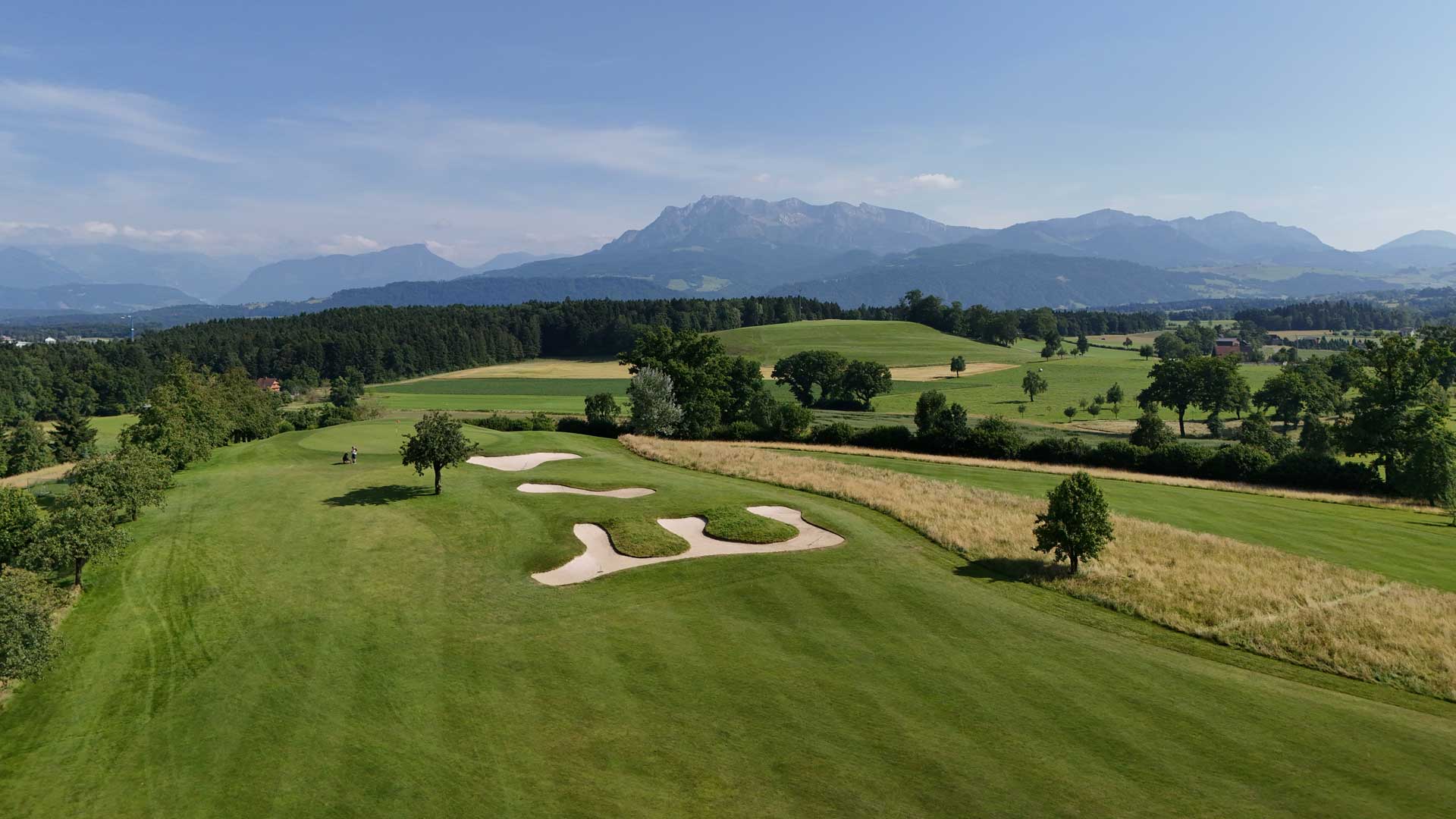
Our 9-hole course at Golf & Naturpark Luzern lies at 550 metres above sea level, nestled between woods and hills, with views of Pilatus, Rigi and Titlis. From the centre of Lucerne, you're there in about a quarter of an hour.
That is exactly what makes the short round work in everyday life here. You drive out after work, play your nine holes, sit in the Bistro afterwards and are back home in the evening. If you want more, play the loop twice and you have your full round. The choice is yours, not the course's.
Are 9-hole rounds the future of golf? They are not the only future, but they are the reason many people have a future in golf at all. If you want to play regularly without sacrificing half a day, the short round is not a cut-price option but the better-fitting format.
Give it a try. Nine holes, two hours, a free evening afterwards.
Choose which cookies we may use. Necessary cookies are always active because the website would not work without them. All others are optional and can be changed at any time.
For basic functions such as the shopping basket, forms and saving your cookie choice.
Shows us anonymously which pages are visited so that we can improve the website. For example Google Analytics.
So that we can show you relevant offers and measure the success of our advertising. For example Google Ads.
Remembers your preferences, for example your preferred location, and embeds content such as maps and reviews.